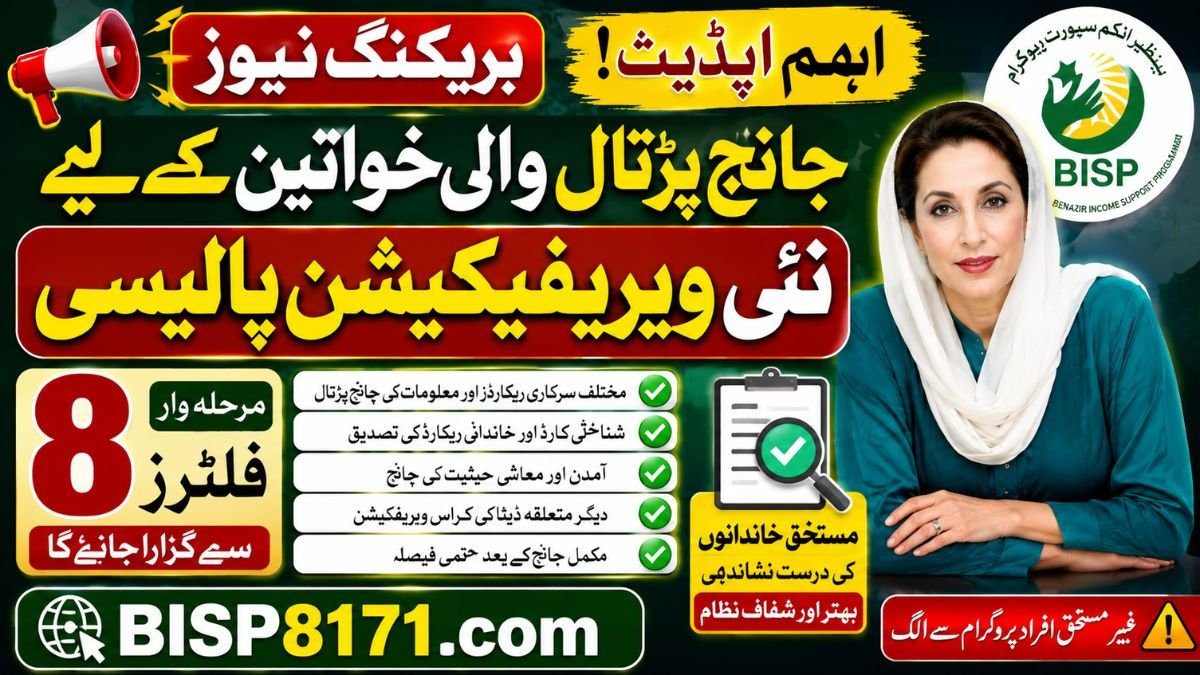
BISP New verification 2026 is an important update for women whose household information is under review for eligibility in the Benazir Income Support Programe. Beneficiaries should understand that verification involves checking household and identity information before eligibility is finalized.
A claim circulating about an “8-filter verification policy” says women under verification will undergo multiple checks involving identity, family information, income, and other government records. However, BISP’s currently available official publications do not clearly confirm a new policy specifically described as “8 filters.” Therefore, this article distinguishes the reported verification process from information officially confirmed by BISP.
Use up and down arrow keys to resize the meta box pane.
اہم اپڈیٹ — ویریفکیشن والی خواتین کے لیے نئی پالیسی
ذرائع کے مطابق BISP ویریفکیشن مزید سخت کی جا رہی ہے۔ جانچ پڑتال والی خواتین کو مختلف سرکاری ریکارڈز اور 8 مرحلہ وار فلٹرز سے گزارا جائے گا۔
شناختی کارڈ اور خاندانی ریکارڈ کی تصدیق*
آمدن اور معاشی صورتحال کی جانچ*
سرکاری ڈیٹا کی کراس ویریفکیشن*
مکمل جانچ کے بعد حتمی فیصلہ*
اہم: حتمی اہلیت کا فیصلہ مکمل تصدیق کے بعد کیا جائے گا۔
BISP maintains the National Socio-Economic Registry (NSER) and beneficiary portals as part of its social protection system. Its official website also provides current programme updates and beneficiary services.
Important Update: Women whose information is under verification should not assume that they have been permanently removed from BISP. Final eligibility depends on the official assessment and household data available to BISP.
BISP Verification 2026 Latest Update
The Benazir Income Support Programme continues to update and verify beneficiary information as part of its social protection and registration system.
BISP’s official updates show continued work on beneficiary registration, digital systems, payments, and the National Socio-Economic Registry. Recent official communications have also emphasized accurate beneficiary information and proper registration procedures.
The reported 8-step or 8-filter verification process should therefore be treated cautiously unless BISP publishes an official notification using that exact terminology.
What Is BISP Verification?
Why Are Women Put Under Verification?
A beneficiary may be subject to additional verification when BISP needs to review household information or confirm whether the family continues to meet programme requirements.
Verification can involve checking information such as:
- CNIC and identity information
- Family information
- Household socioeconomic information
- Registration/NSER data
- Government records
- Information submitted during the survey
- Other available data used for eligibility assessment
The purpose is to ensure that assistance reaches households that meet the programme’s eligibility requirements.
Reported 8 Filters for BISP Verification
The following points reflect the reported verification process, not a separately confirmed BISP announcement titled “8 Filters.”
1. CNIC Verification
The beneficiary’s Computerized National Identity Card (CNIC) information may be checked against official identity records.
Accurate CNIC information is important because BISP services and beneficiary records depend on verified identity information.
2. Family Record Verification
Household and family information may be reviewed to determine whether the information provided during registration is consistent with available records.
3. Socioeconomic Information Check
Household socioeconomic information is an important part of determining eligibility for social protection programmes.
BISP’s system uses socioeconomic data to identify households for programme assistance.
4. Income and Economic Status Assessment
The reported verification process also includes checking information relevant to the household’s financial and economic circumstances.
Beneficiaries should provide accurate information during official surveys and registration processes.
5. Government Data Cross-Verification
Information may be compared with relevant government records and databases where applicable.
This type of cross-checking helps identify inconsistencies between information provided by applicants and available official records.
6. Household Data Review
The household’s overall information may be reviewed as part of the eligibility assessment.
Changes in family circumstances can affect the information recorded in the beneficiary database.
7. Additional Data Checks
Where required, additional information may be reviewed before a final eligibility decision is made.
Beneficiaries should respond only through official BISP channels if additional information is requested.
8. Final Eligibility Decision
After the relevant verification checks, BISP determines the beneficiary’s status according to applicable programme rules and available data.
A verification status does not automatically mean that a woman has been permanently disqualified.
BISP Verification Status 2026
Women may see different statuses while their information is being processed.
Under Verification
This generally means the beneficiary’s information is being reviewed and a final decision has not yet been made.
Eligible
The beneficiary continues to meet the applicable eligibility requirements.
Ineligible
The household does not meet the applicable criteria based on the assessment.
Reverification Required
In some circumstances, additional information or an updated survey may be required.
Beneficiaries should rely on the official BISP portal, SMS notifications, or BISP offices for their individual status rather than unofficial messages.
How to Check BISP Eligibility and Verification Status
Check Through the Official BISP System
Beneficiaries can use the official BISP channels to check programme-related information.
The BISP website provides access to beneficiary and programme portals, including the BISP Beneficiaries Portal and Kafaalat Portal.
Keep your CNIC number available when checking your status.
Is There a New 8-Filter BISP Policy?
Official Confirmation Status
At the time of publication, the official BISP material reviewed for this article does not clearly identify a newly introduced policy officially titled an “8-filter verification policy.”
This distinction is important because social media posts and unofficial websites can sometimes describe routine verification or data checks as a new policy.
BISP’s official 2026 press releases currently highlight areas including digital wallets, beneficiary payments, mobile registration, and improvements to social protection systems.
Therefore, beneficiaries should wait for an official BISP notification before treating a specific “8 filters” list as a confirmed government policy.
What Should Women Under Verification Do?
Women whose BISP status is under verification should follow these steps:
- Keep the original CNIC available.
- Check the official BISP status through authorized channels.
- Make sure household information is accurate.
- Visit an official BISP office if an update or survey is required.
- Do not pay anyone for verification or registration.
- Keep official receipts and documents.
- Ignore messages from unofficial numbers claiming to represent BISP.
BISP has specifically warned that there is no fee for its survey and that 8171 is the official BISP number for beneficiary messages.
BISP Verification Does Not Mean Immediate Removal
One of the most important points for beneficiaries is that being placed under verification should not automatically be interpreted as permanent disqualification.
Verification is part of determining whether the household’s information and eligibility meet programme requirements.
The final decision should be based on the official BISP record.
BISP Survey and Re-Survey Information
BISP has also issued guidance stating that there is no survey fee and that beneficiaries should not pay individuals claiming to offer paid registration or verification services.
Women should use official registration and verification facilities rather than unofficial agents.
BISP Verification 2026 FAQs
What is BISP verification 2026?
BISP verification is the process of reviewing beneficiary and household information to determine whether the family continues to meet the applicable programme eligibility requirements.
Are there really 8 filters in BISP verification?
An 8-filter verification process is being reported, but the official BISP sources reviewed do not currently confirm a separate new policy officially named “8 filters.” Beneficiaries should wait for an official notification before treating that exact list as confirmed.
Does verification mean I am disqualified from BISP?
No. Being under verification does not by itself mean permanent disqualification. The final status depends on the official assessment.
Is there a fee for BISP verification or survey?
No. BISP states that its survey is free of charge. Anyone demanding money for a BISP survey should be treated with caution.
What is the official BISP SMS number?
BISP has stated that 8171 is its official number for beneficiary messages. Messages from other numbers claiming to be BISP should be treated as potentially fraudulent.
What should I do if my information needs updating?
Use official BISP registration or designated service channels and provide accurate household information. Do not pay an unauthorized person to update your record.
Google Featured Snippet Answer
BISP verification 2026 involves reviewing beneficiary identity, family, socioeconomic and other available information before eligibility is finalized. An “8-filter verification policy” is being reported, but BISP’s currently available official publications do not clearly confirm a new policy using that exact name. Women under verification should check their status through official BISP channels.
Final Update for BISP Beneficiaries
Women whose BISP records are under verification should remain cautious about unverified claims circulating on social media. The safest approach is to check the official BISP beneficiary system, follow instructions from authorized BISP offices, and use 8171 for official beneficiary messages.
BISP’s official website continues to publish programme updates covering beneficiary services, registration, payments, digital wallets and social protection initiatives.